Lugia Card Values
Lugia's Neo Genesis debut is one of the most iconic cards in the game's history, and its modern V/VSTAR reprints in Silver Tempest carried that reputation into current-era pricing.
- Cards found
- 37
- Most expensive
- Lugia · $4,500.00
- Least expensive
- $0.47
- Sets appeared in
- 24
Highest-priced Lugia cards
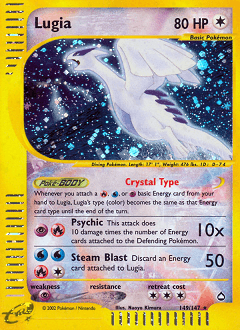




Lugia EX prints



Recent Lugia releases
Showing 10 of 10 cards





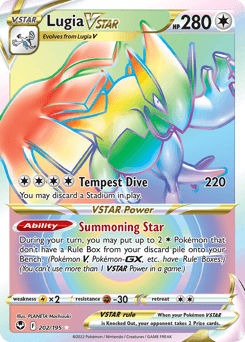

Every Lugia card
Showing 37 of 37 cards
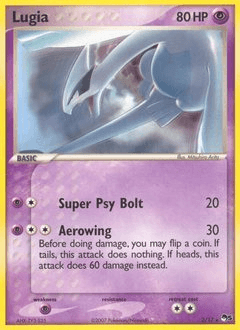
Lugia
#2 · Rare
$125.00

Lugia
#9 · Rare Holo
$1,134.85

Lugia
#14 · Rare Holo
$220.01

Lugia
#15 · Rare Holo
$8.73

Lugia
#20 · Rare
$147.50

Lugia
#22 · Rare
$0.75

Lugia
#29 · Rare
$24.70

Lugia-EX
#68 · Rare Holo EX
$15.76

Lugia
#78 · Rare
$3.37

Lugia BREAK
#79 · Rare BREAK
$43.53
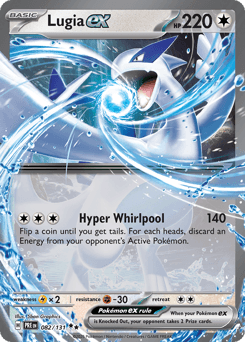
Lugia ex
#82 · Double Rare
$1.59

Lugia-EX
#94 · Rare Ultra
$212.33
Lugia value guide
Lugia's card values are anchored by one landmark print: the original Neo Genesis holo, which became one of the earliest widely-chased legendary cards outside Base Set itself and still trades almost entirely on scarcity and grading today. That vintage print set expectations that modern Lugia V and VSTAR reprints, appearing in sets like Silver Tempest, haven't fully matched — newer prints are priced on current demand and print run rather than on the same historical scarcity. A graded Neo Genesis Lugia in strong condition typically commands a real premium over a raw copy, since condition differences are easy to misjudge at that price tier. If you're valuing a Lugia card, confirming whether it's the original Neo Genesis print or a later reprint is the single most important step — the two markets don't really overlap.
Other Pokémon collectors also track
Where Lugia shows up
- Prismatic Evolutions1 card · 2025
- Silver Tempest6 cards · 2022
- Celebrations1 card · 2021
- Darkness Ablaze1 card · 2020
- Vivid Voltage1 card · 2020
- SWSH Black Star Promos1 card · 2019
- Team Up1 card · 2019
- Lost Thunder3 cards · 2018
- SM Black Star Promos1 card · 2017
- Fates Collide2 cards · 2016
- Ancient Origins2 cards · 2015
- Legendary Treasures1 card · 2013
- Plasma Storm2 cards · 2013
- XY Black Star Promos1 card · 2013
- BW Black Star Promos1 card · 2011
- Call of Legends2 cards · 2011
- HeartGold & SoulSilver2 cards · 2010
- HGSS Black Star Promos1 card · 2010
- POP Series 51 card · 2007
- Secret Wonders1 card · 2007
- Unseen Forces2 cards · 2005
- Aquapolis1 card · 2003
- Neo Revelation1 card · 2001
- Neo Genesis1 card · 2000
Track Lugia’s value over time
Prices on this page update daily from current market activity, not a fixed catalog value — a card that looked flat last month can move quickly once a new set or reprint shifts supply. If you’re watching a specific Lugia card closely, these tools help turn a single price into a fuller picture.
What moves a Lugia card’s price
- Card type & subtype
- A base Lugia print, an ex/EX, a VMAX, or a VSTAR command very different prices even from the same set — subtype almost always matters more than the Pokémon itself.
- Set & release era
- Vintage Lugia cards trade on scarcity built up over 20+ years; modern Lugia cards trade on print run and how limited that specific set's pull rate was.
- Condition
- Whitening, edge wear, and surface scratches all pull an otherwise desirable Lugia card down in price, sometimes by more than the rarity difference between two prints.
- Rarity & print run
- A holo or alt-art Lugia from a small, short-lived print run typically outprices a common reprint of the same card from a mass-produced set.
- Grading
- A professionally graded Lugia — PSA, CGC, or BGS — removes condition guesswork and can carry a meaningfully higher price than the same card raw, especially at the top grades.
Frequently asked questions
Why is the original Neo Genesis Lugia considered such a landmark card?
It was the set's headline legendary and became one of the earliest widely-chased holo legendaries outside Base Set itself, a reputation that's kept it in steady demand for decades.
Do the newer Lugia V and VSTAR reprints compare in value to the Neo Genesis original?
Not usually — the vintage original trades on scarcity and grading, while the newer Silver Tempest-era reprints trade mainly on current demand and print run. They rarely reach the same price tier.
Is a graded Lugia worth significantly more than a raw copy?
For the vintage Neo Genesis holo, often yes, substantially — condition is hard to judge accurately without grading at that price tier, so a certified grade removes a lot of buyer hesitation.
Is the 3rd Movie promo Lugia the same card as the Neo Genesis holo?
No, and they get mixed up constantly. The 3rd Movie promo carries its own black-star promo numbering and print run, separate from the Neo Genesis set release, and it typically trades for a fraction of the Neo Genesis holo's price even though the artwork looks similar at a glance.
Collector’s tip
The original Neo Genesis Lugia and its modern V/VSTAR reprints are two very different markets — confirm which one you're holding before comparing prices.
More Pokémon to check
Scan any Lugia card
Point your phone's camera at a Lugia card and Slab identifies it and pulls its live price instantly — free on iOS.