Blastoise Card Values
Blastoise rounds out the original Base Set starter trio alongside Charizard and Venusaur, and its VMAX and ex printings still draw steady collector interest.
- Cards found
- 46
- Most expensive
- Blastoise ex · $650.45
- Least expensive
- $0.25
- Sets appeared in
- 27
Highest-priced Blastoise cards
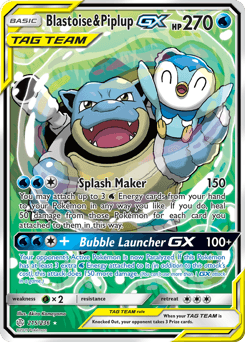
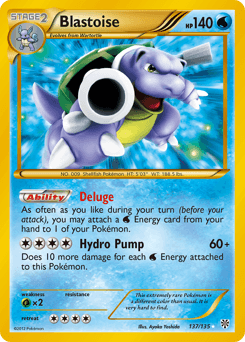
Blastoise EX prints
Showing 15 of 15 cards
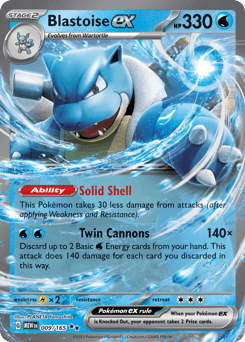
Blastoise ex
#9 · Double Rare
$2.36
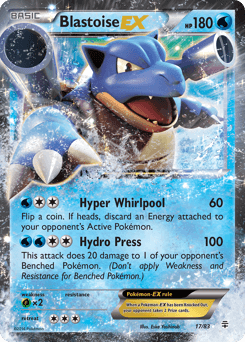
Blastoise-EX
#17 · Rare Holo EX
$15.88
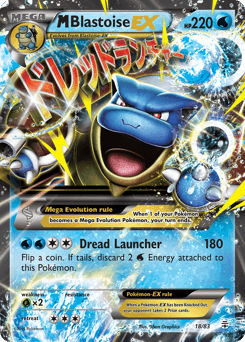
M Blastoise-EX
#18 · Rare Holo EX
$30.84
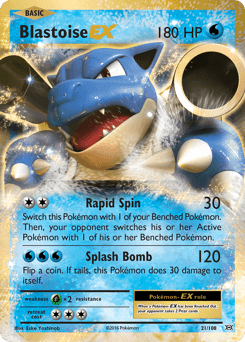
Blastoise-EX
#21 · Rare Holo EX
$6.42
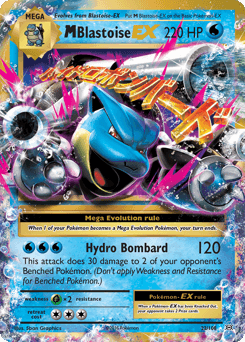
M Blastoise-EX
#22 · Rare Holo EX
$21.22
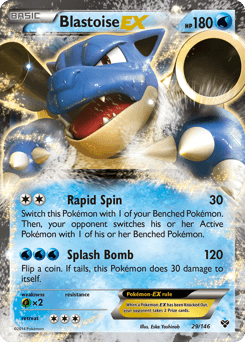
Blastoise-EX
#29 · Rare Holo EX
$11.44
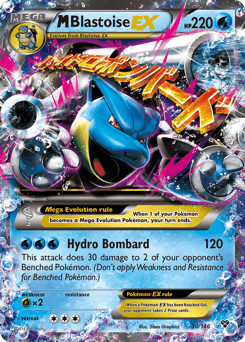
M Blastoise-EX
#30 · Rare Holo EX
$32.52
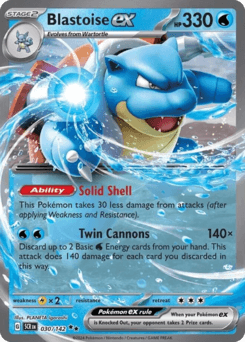
Blastoise ex
#30 · Double Rare
$2.97
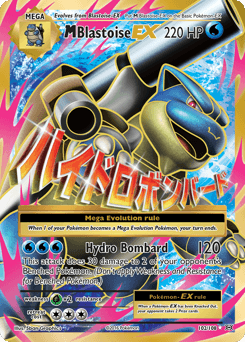
M Blastoise-EX
#102 · Rare Ultra
$69.75
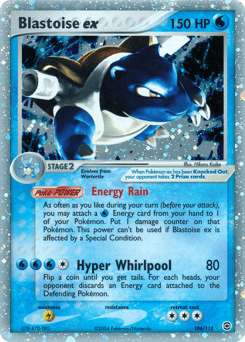
Blastoise ex
#104 · Rare Holo EX
$650.45
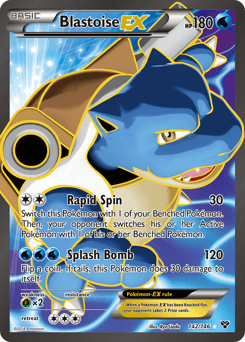
Blastoise-EX
#142 · Rare Ultra
$161.07
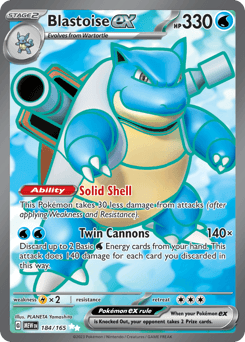
Blastoise ex
#184 · Ultra Rare
$19.75
Original Base Set-era Blastoise cards
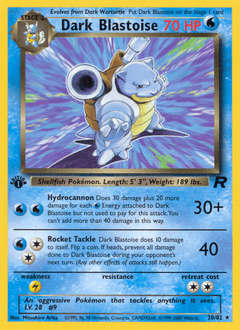
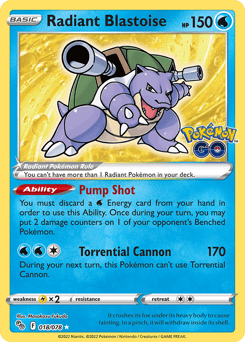
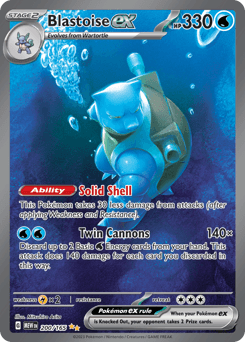
Recent Blastoise releases
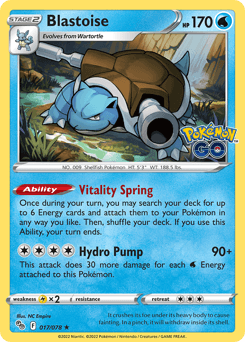
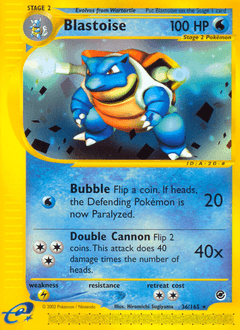
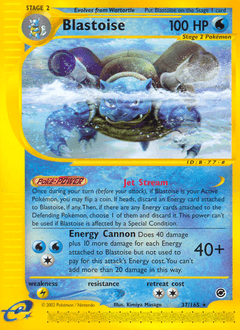
Early Blastoise printings
Every Blastoise card
Showing 46 of 46 cards
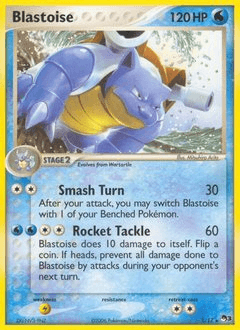
Blastoise
#1 · Rare
$217.50

Blastoise δ
#2 · Rare Holo
$260.70
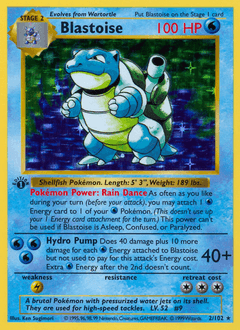
Blastoise
#2 · Rare Holo
$222.34
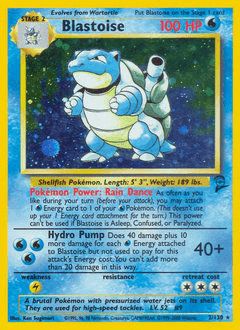
Blastoise
#2 · Rare Holo
$154.64
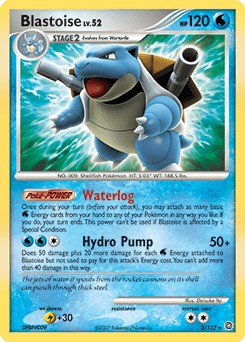
Blastoise
#2 · Rare Holo
$107.00
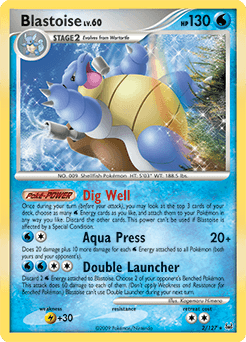
Blastoise
#2 · Rare Holo
$69.66
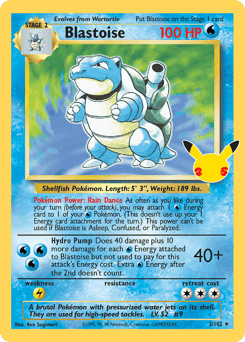
Blastoise
#2 · Classic Collection
$16.06
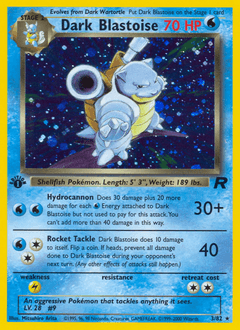
Dark Blastoise
#3 · Rare Holo
$488.59
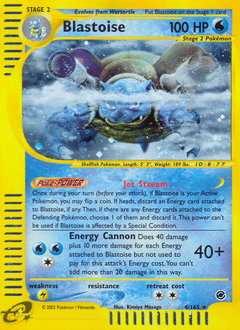
Blastoise
#4 · Rare Holo
$287.00
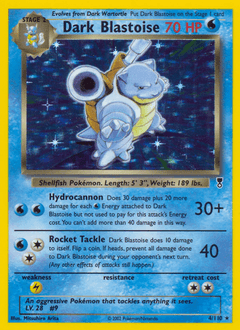
Dark Blastoise
#4 · Rare Holo
$234.65
Blastoise ex
#9 · Double Rare
$2.36
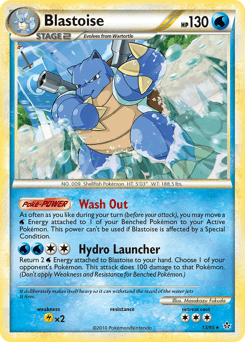
Blastoise
#13 · Rare
$17.27
Blastoise value guide
Blastoise rounds out the Base Set starter trio alongside Charizard and Venusaur, but its prices have never quite kept pace with Charizard's — fire-type appeal and pull-rate mythology around Charizard specifically outran its water-type sibling despite both being similarly scarce in the original print run. That gap holds in the modern game too: Blastoise ex and VMAX prints see steady collector interest but rarely approach Charizard-tier prices for a comparable set and subtype. Vintage Blastoise still follows the same rules as any Base Set-era card — a genuine first-edition or shadowless holo in strong condition is usually worth grading, since the resale gap between raw and graded copies is significant at that tier. For modern Blastoise prints, set and print run matter more than any Charizard-adjacent reputation.
Other Pokémon collectors also track
Where Blastoise shows up
- Stellar Crown1 card · 2024
- 1513 cards · 2023
- Pokémon GO2 cards · 2022
- Celebrations: Classic Collection1 card · 2021
- Cosmic Eclipse4 cards · 2019
- SWSH Black Star Promos2 cards · 2019
- Team Up1 card · 2019
- Unbroken Bonds2 cards · 2019
- SM Black Star Promos1 card · 2017
- Evolutions4 cards · 2016
- Generations2 cards · 2016
- XY3 cards · 2014
- Plasma Blast1 card · 2013
- Plasma Storm1 card · 2013
- XY Black Star Promos2 cards · 2013
- Boundaries Crossed1 card · 2012
- HS—Unleashed1 card · 2010
- Platinum1 card · 2009
- Secret Wonders1 card · 2007
- Crystal Guardians2 cards · 2006
- POP Series 31 card · 2006
- FireRed & LeafGreen1 card · 2004
- Expedition Base Set3 cards · 2002
- Legendary Collection1 card · 2002
- Base Set 21 card · 2000
- Team Rocket2 cards · 2000
- Base1 card · 1999
Track Blastoise’s value over time
Prices on this page update daily from current market activity, not a fixed catalog value — a card that looked flat last month can move quickly once a new set or reprint shifts supply. If you’re watching a specific Blastoise card closely, these tools help turn a single price into a fuller picture.
What moves a Blastoise card’s price
- Card type & subtype
- A base Blastoise print, an ex/EX, a VMAX, or a VSTAR command very different prices even from the same set — subtype almost always matters more than the Pokémon itself.
- Set & release era
- Vintage Blastoise cards trade on scarcity built up over 20+ years; modern Blastoise cards trade on print run and how limited that specific set's pull rate was.
- Condition
- Whitening, edge wear, and surface scratches all pull an otherwise desirable Blastoise card down in price, sometimes by more than the rarity difference between two prints.
- Rarity & print run
- A holo or alt-art Blastoise from a small, short-lived print run typically outprices a common reprint of the same card from a mass-produced set.
- Grading
- A professionally graded Blastoise — PSA, CGC, or BGS — removes condition guesswork and can carry a meaningfully higher price than the same card raw, especially at the top grades.
Frequently asked questions
Why does Blastoise get less attention than Charizard despite being from the same Base Set trio?
Fire-type appeal and pull-rate mythology around Charizard specifically outran its water-type sibling, even though both were similarly scarce in the original 1999 print run. Blastoise still holds steady demand of its own, just at a lower ceiling.
Are modern Blastoise ex or VMAX cards worth collecting?
Worth collecting for fans of the Pokémon, though they rarely reach Charizard-tier prices for a comparable set and subtype. Check current comps for the specific print rather than assuming Base Set reputation carries over.
Is a first-edition Base Set Blastoise worth grading?
Usually yes for a genuine first-edition holo in good condition — the resale gap between raw and graded copies is significant at that tier, the same as it is for Charizard and Venusaur.
Does the shadowless premium on Blastoise hold up as well as it does for Charizard?
Generally not to the same degree — Charizard's fire-type demand pulls a larger premium onto every edition tier, shadowless included, than the same edition markers pull for Blastoise. A shadowless Blastoise still sells above an unlimited copy, just by a narrower margin than the equivalent Charizard gap.
Collector’s tip
A shadowless or first-edition Base Set Blastoise is worth checking closely — look for the missing drop-shadow around the art box before assuming it's a common unlimited print.
More Pokémon to check
Scan any Blastoise card
Point your phone's camera at a Blastoise card and Slab identifies it and pulls its live price instantly — free on iOS.