Venusaur Card Values
Venusaur, the third Base Set starter, has picked up VMAX and ex printings in most modern sets and remains a consistent grass-type collector favorite.
- Cards found
- 48
- Most expensive
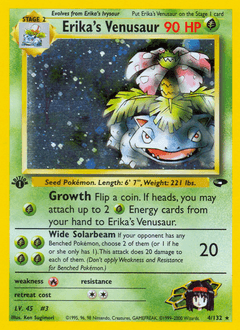
- Erika's Venusaur · $650.00
- Least expensive
- $0.24
- Sets appeared in
- 28
Highest-priced Venusaur cards

Venusaur EX prints
Showing 18 of 18 cards

Venusaur-EX
#1 · Rare Holo EX
$11.00
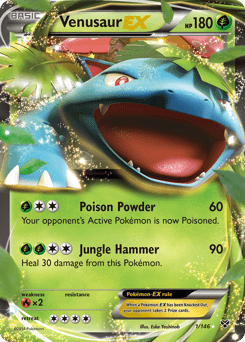
Venusaur-EX
#1 · Rare Holo EX
$6.89
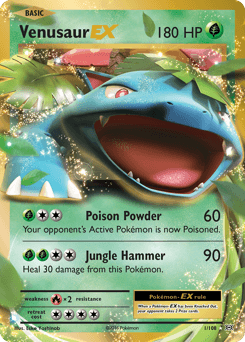
Venusaur-EX
#1 · Rare Holo EX
$5.01
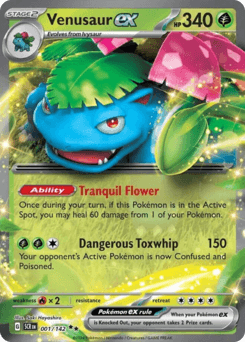
Venusaur ex
#1 · Double Rare
$1.80

M Venusaur-EX
#2 · Rare Holo EX
$24.08
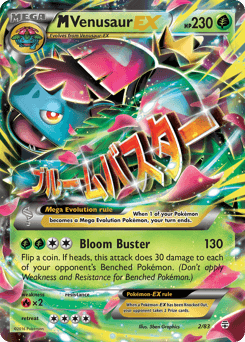
M Venusaur-EX
#2 · Rare Holo EX
$22.65

M Venusaur-EX
#2 · Rare Holo EX
$12.46
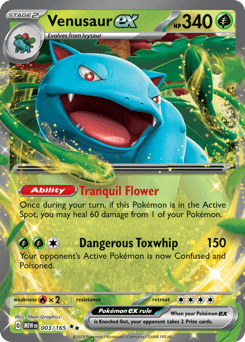
Venusaur ex
#3 · Double Rare
$0.97
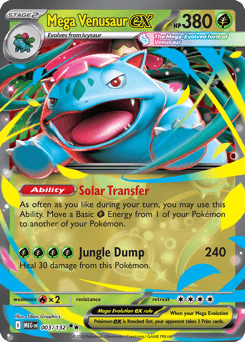
Mega Venusaur ex
#3 · Double Rare
$0.87

M Venusaur-EX
#100 · Rare Ultra
$37.50
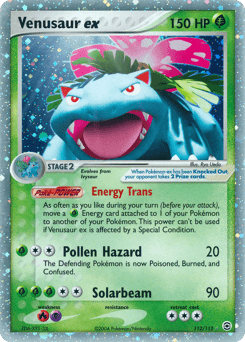
Venusaur ex
#112 · Rare Holo EX
$480.01
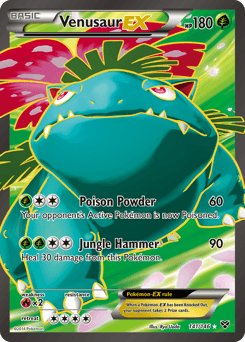
Venusaur-EX
#141 · Rare Ultra
$102.62
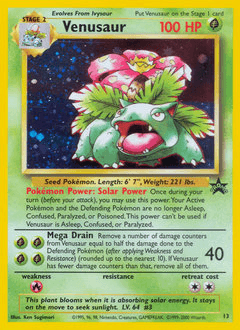
Original Base Set-era Venusaur cards
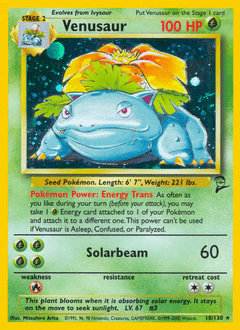
Recent Venusaur releases
Showing 10 of 10 cards

Venusaur V
#1 · Rare Holo V
$2.50
Venusaur ex
#1 · Double Rare
$1.80
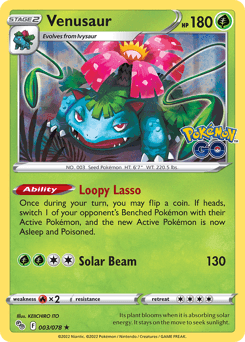
Venusaur
#3 · Rare Holo
$1.43
Venusaur ex
#3 · Double Rare
$0.97
Mega Venusaur ex
#3 · Double Rare
$0.87
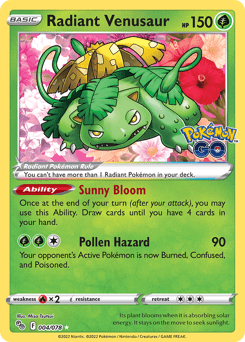
Radiant Venusaur
#4 · Radiant Rare
$8.37

Mega Venusaur ex
#155 · Ultra Rare
$10.94

Mega Venusaur ex
#177 · Special Illustration Rare
$145.81
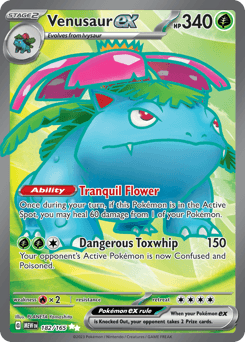
Venusaur ex
#182 · Ultra Rare
$12.74
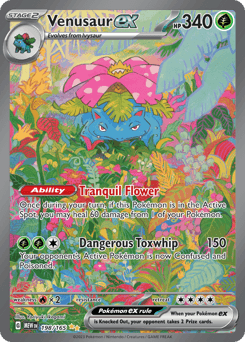
Venusaur ex
#198 · Special Illustration Rare
$96.02
Early Venusaur printings
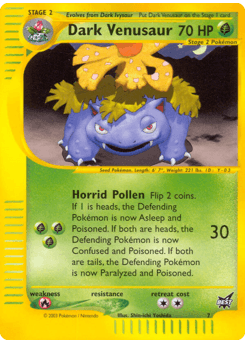
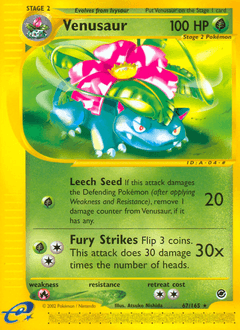
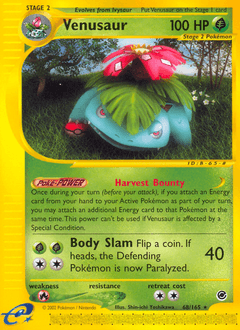
Every Venusaur card
Showing 48 of 48 cards
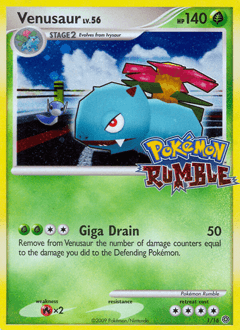
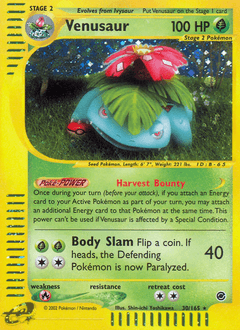
Venusaur
#1
$279.90

Celebi & Venusaur-GX
#1 · Rare Holo GX
$57.53
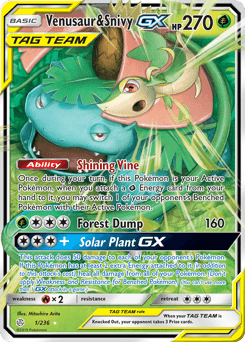
Venusaur & Snivy-GX
#1 · Rare Holo GX
$26.38
Venusaur-EX
#1 · Rare Holo EX
$11.00
Venusaur-EX
#1 · Rare Holo EX
$6.89
Venusaur-EX
#1 · Rare Holo EX
$5.01
Venusaur V
#1 · Rare Holo V
$2.50
Venusaur ex
#1 · Double Rare
$1.80
M Venusaur-EX
#2 · Rare Holo EX
$24.08
M Venusaur-EX
#2 · Rare Holo EX
$22.65
M Venusaur-EX
#2 · Rare Holo EX
$12.46
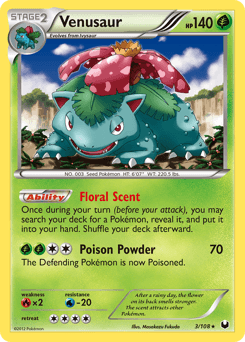
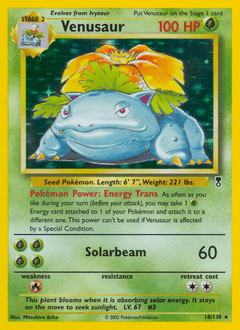
Venusaur
#3 · Rare Holo
$15.01
Venusaur value guide
Venusaur is the third Base Set starter, and historically the least chased of the trio — grass-type Pokémon have generally trailed fire and water types in collector demand, even when the print scarcity is nearly identical. That gap shows up in both vintage and modern prints: a Base Set Venusaur holo typically sells for less than an equivalent-condition Charizard or Blastoise from the same set, and modern Venusaur ex/VMAX alt arts see real but comparatively modest demand. None of that means Venusaur is a bad hold — a genuine first-edition or clean unlimited Base Set holo still benefits meaningfully from grading, the same way its Base Set siblings do, since condition differences are hard to judge accurately without it. Set, edition, and condition still explain most of a given Venusaur card's price.
Other Pokémon collectors also track
Where Venusaur shows up
- Mega Evolution3 cards · 2025
- Stellar Crown1 card · 2024
- 1513 cards · 2023
- Pokémon GO2 cards · 2022
- Champion's Path1 card · 2020
- Cosmic Eclipse3 cards · 2019
- SWSH Black Star Promos2 cards · 2019
- Team Up3 cards · 2019
- Shining Legends1 card · 2017
- SM Black Star Promos2 cards · 2017
- Evolutions4 cards · 2016
- Generations2 cards · 2016
- XY3 cards · 2014
- XY Black Star Promos2 cards · 2013
- Dark Explorers1 card · 2012
- Pokémon Rumble1 card · 2009
- Supreme Victors1 card · 2009
- Secret Wonders1 card · 2007
- Crystal Guardians1 card · 2006
- POP Series 21 card · 2005
- FireRed & LeafGreen1 card · 2004
- Best of Game1 card · 2002
- Expedition Base Set3 cards · 2002
- Legendary Collection1 card · 2002
- Base Set 21 card · 2000
- Gym Challenge1 card · 2000
- Base1 card · 1999
- Wizards Black Star Promos1 card · 1999
Track Venusaur’s value over time
Prices on this page update daily from current market activity, not a fixed catalog value — a card that looked flat last month can move quickly once a new set or reprint shifts supply. If you’re watching a specific Venusaur card closely, these tools help turn a single price into a fuller picture.
What moves a Venusaur card’s price
- Card type & subtype
- A base Venusaur print, an ex/EX, a VMAX, or a VSTAR command very different prices even from the same set — subtype almost always matters more than the Pokémon itself.
- Set & release era
- Vintage Venusaur cards trade on scarcity built up over 20+ years; modern Venusaur cards trade on print run and how limited that specific set's pull rate was.
- Condition
- Whitening, edge wear, and surface scratches all pull an otherwise desirable Venusaur card down in price, sometimes by more than the rarity difference between two prints.
- Rarity & print run
- A holo or alt-art Venusaur from a small, short-lived print run typically outprices a common reprint of the same card from a mass-produced set.
- Grading
- A professionally graded Venusaur — PSA, CGC, or BGS — removes condition guesswork and can carry a meaningfully higher price than the same card raw, especially at the top grades.
Frequently asked questions
Why is Venusaur the least chased of the three Base Set starters?
Grass-type Pokémon have historically trailed fire and water types in collector demand, even when the print scarcity between the three starters is nearly identical. It's a demand gap, not a scarcity one.
Do Venusaur ex or VMAX cards hold value the way Charizard's do?
Generally a lower ceiling, though scarce alt-art prints still see real demand. Compare a specific Venusaur print against others from its own set rather than against Charizard's numbers.
Is my Base Set Venusaur worth grading before I sell it?
For a genuine first-edition or clean unlimited holo, usually yes — condition swings its price a lot at that tier, the same as it does for Charizard and Blastoise from the same set.
Does a Venusaur card's price move together with Bulbasaur and Ivysaur from the same set?
Not really. As the final evolution, Venusaur usually carries most of a set's value for that evolution line, while Bulbasaur and Ivysaur trail well behind as ordinary commons. Buying a Venusaur on the assumption its earlier-stage evolutions will hold similar value is usually a mismatch.
Collector’s tip
Don't assume a Venusaur card is worth less just because grass-types trend lower — a genuine first-edition or shadowless Base Set holo still benefits meaningfully from grading.
More Pokémon to check
Scan any Venusaur card
Point your phone's camera at a Venusaur card and Slab identifies it and pulls its live price instantly — free on iOS.